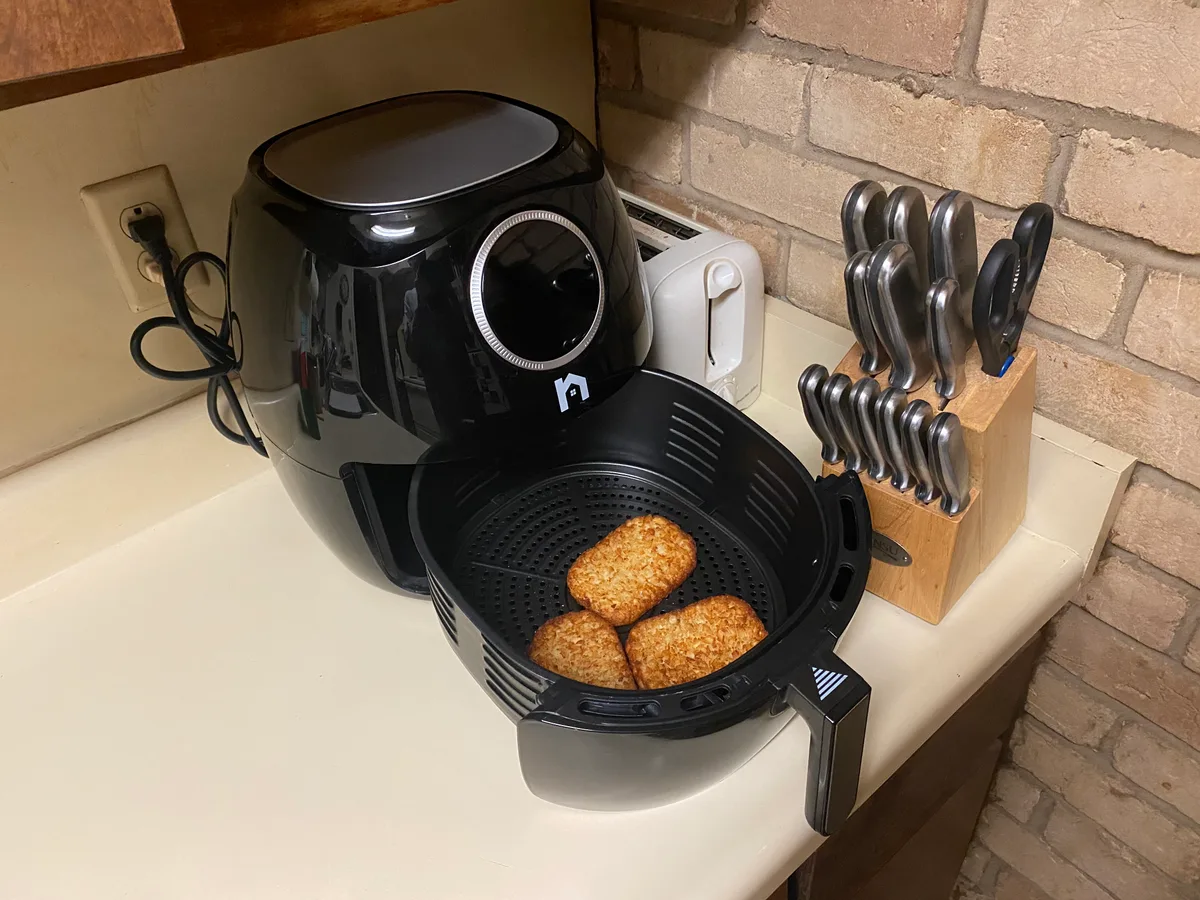
The footprint of a basket air fryer changes when you use it. Its closed body may sit comfortably on a counter, but withdrawing the basket adds another movement to the space plan. You also need an appropriate place to handle hot removable parts according to the manufacturer’s instructions.
A useful comparison therefore includes a closed rectangle, a movement path and operating requirements. We have not measured basket travel or tested performance for the products mentioned here. Missing dimensions should stay marked as missing until verified.
Begin with exact-model exterior dimensions
Copy dimensions from the manufacturer’s US listing and keep the axis labels. For example, SharkNinja lists the AF141 at 14.84 inches long, 11.34 inches wide and 10.55 inches high. The manufacturer describes it as a five-quart model. These specifications identify the body and capacity; they do not publish every movement involved in using it.
Do not mix a measurement from one retailer with another model’s photograph. Similar-looking appliances can have different handles, bodies or accessories. Your paper comparison should name the exact model beside every dimension.
Add the basket’s movement path
Find out how the basket withdraws and how far it must move before you can lift or handle it as directed. If that information is absent from the manual and specification page, ask the manufacturer. Do not subtract an estimated basket length from an unrelated product or assume the handle marks the full extent of movement.
Imagine the drawer opening with the objects you normally keep nearby. A coffee setup, chopping board or dish rack can conflict with that path even when it does not overlap the closed appliance. Assess the kitchen in its ordinary working condition rather than in a temporarily empty staged arrangement.
Plan where hot parts can go
Consider the sequence of removing food, handling the basket and putting it back. Follow the exact manual for appropriate surfaces and accessories. Do not assume a decorative mat, ordinary board or adjacent shelf is approved for contact with a hot part.
As a planning exercise, draw a separate landing zone on paper without treating the drawing as a safety approval. The aim is to discover whether you have enough practical workspace to follow the instructions. If the answer depends on clearing your only preparation area every time, include that inconvenience in your purchase decision.
Keep ventilation separate from geometry
A rectangle fitting on a counter does not establish a suitable operating position. Review model-specific wall, cabinet, surface and electrical requirements. Required clearance is additional to the body dimensions and can change the suitability of an otherwise attractive corner.
Avoid treating a hand-span rule or a number from another brand as universal. Also distinguish a place where you can store a cool appliance from the place where it operates. The small-kitchen goal is a workable routine, not the tightest possible arrangement around a running heating appliance.
Compare useful capacity and cleanup
The quoted volume of a basket does not fully describe its usable flat cooking area. Think about the meals you normally prepare, the arrangement the recipe and manual require, and whether you would need repeated batches. Without measurements or tests, do not assume that two equal-volume baskets have equal usable shapes.
Finally, check how the basket and insert are cleaned and where they will dry. A compact body can still introduce bulky removable parts. Choose the appliance only when its closed size, movement, operating location and cleanup routine all make sense in the space you actually have.
Frequently asked questions
Does a five-quart capacity tell me how much counter space is needed?
No. Capacity and exterior size measure different things, and neither alone describes basket travel or operating clearances.
Can I estimate the open depth from a photo?
A photo is not a dependable dimensional reference. Ask the manufacturer when the open measurement is not published.
Sources & editorial method
We used published documentation for the comparisons and examples in this guide. We have not independently tested these products. Manufacturer instructions for your exact model take precedence over general planning advice.